Archive for the ‘Steven Brust’ Category
Two more Vlad Taltos Books
Posted on: September 24, 2019
You saw this article on BoingBoing about Steven Brust and Roger Zelazny, yeah?
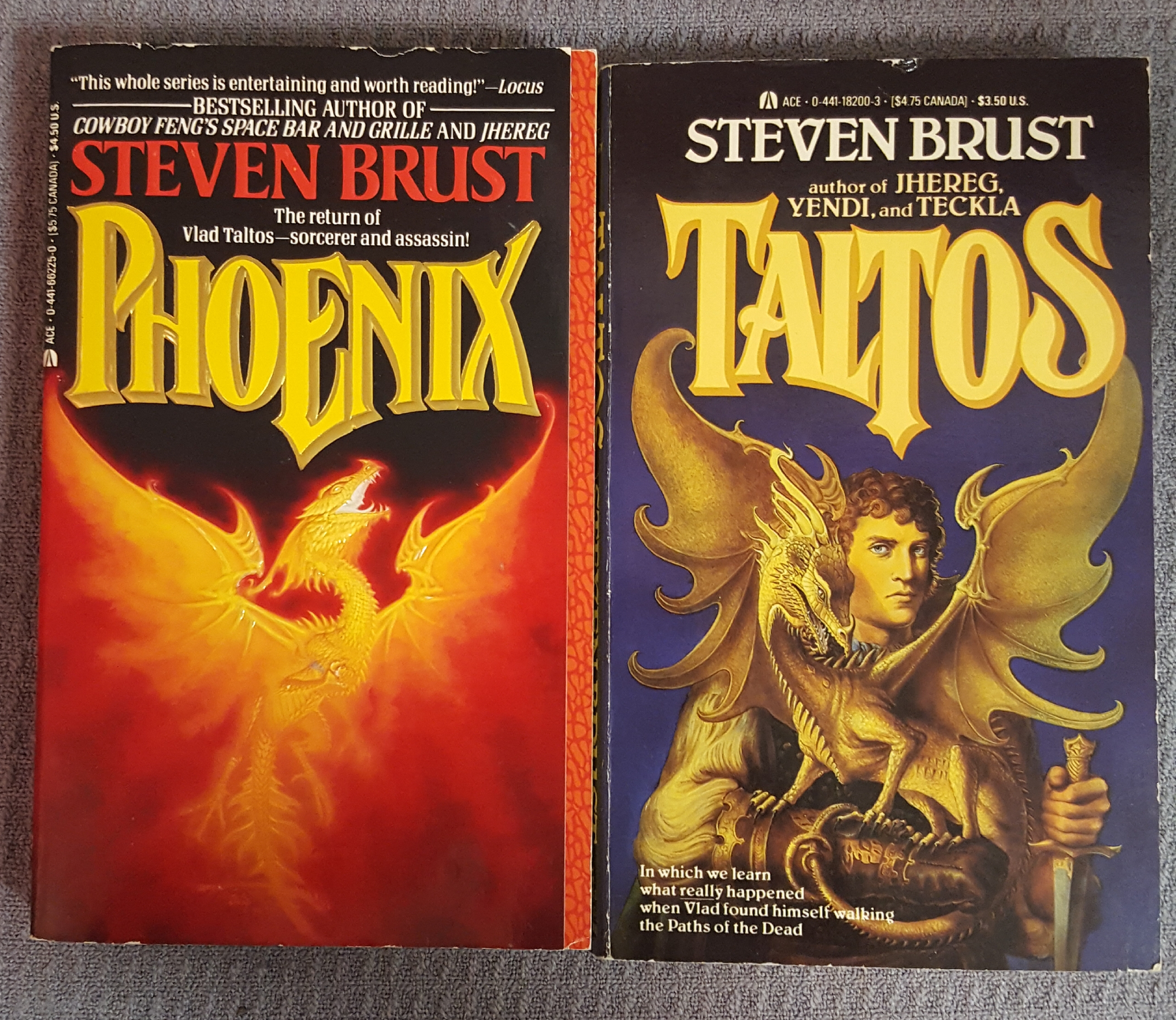
I’m going to talk about these books in the order I read them. Even though in hindsight, I should have read them in the opposite order. Oh well.
Minor spoilers and major teases ahead.
So, I haven’t read every single book in this series, and the ones that I have read, I haven’t exactly read them in order. But it’s okay, because the books in this series are sorta kinda meant to be read in whatever order you please, and then reread in whatever order you please. I kinda don’t want to get to the point where I’ve read every book in this series? Like, I always want there to be some surprises left. Lol I’ll be 90 years old and blind, and that’s when I’ll decide to read the one I haven’t read, and then I’ll be shouting in the middle of the night at the nursing home “That’s how Teldra and Morrolan met? You are fucking shitting me!”
These books are my comfort reads. When I need something I know I’m going to love from page one, I pick up a Vlad Taltos book, and I’m a happy camper for a few days.
Also, I’ve got a little bit of history with this series.

Phoenix was written in 1990, and is chronologically the approximate 9th book in Brust’s Vlad Taltos series. (yeah, this isn’t that kind of fantasy and these aren’t those dragons. Just so we’re clear)
This is the book where Vlad realizes his marriage is over. Some readers will gloss right over those scenes, I had a really tough time. I’m a softy, ok? And he still loves her. And I think she still loves him. And I get why they split, and I respect it, but I can still cry about it, ok?
Anyway, the book opens with Vlad getting killed. And he thinks about the Demon Goddess Verra, and how he
“had once traveled several thousand miles through supernatural horrors and the realm of the dead men just to bid her good-day”
And I thought that sounded hella cool, so I pulled Taltos off my bookshelf to read next. Not only does Verra answer when Vlad calls out to her with his dying breath, she gives him a job. All Vlad’s gotta do is kill a guy. He’s pretty good at that, so no problem. Except, his target is the king of a tiny island country that the Empire doesn’t have anything to do with, because sorcery doesn’t work there. Sorcery is what allows the Empire to function, so if you could go somewhere where it doesn’t work . . . .
There’s also a drummer who might be a spy.
And there’s a revolution brewing at home. This book has buckets of societal questions about the rights of the lower classes and the rights of minority ethnic groups, and the right to protest and the right to be heard. But this isn’t a book about how to start a revolution, it’s not a youth anthem, it’s not a book about toppling the system, this ain’t Hunger Games, you know. In truth, Vlad would very much like for things to quiet down and go back to the way they were. He just wants to live a quiet life where he gets paid to kill people, and runs illegal gambling dens, you know?
two books I enjoyed
Posted on: September 14, 2019
instead of a some long drawn out reviews, howsabout a few words on some books I enjoyed recently? You’d like that? yeah, me too.
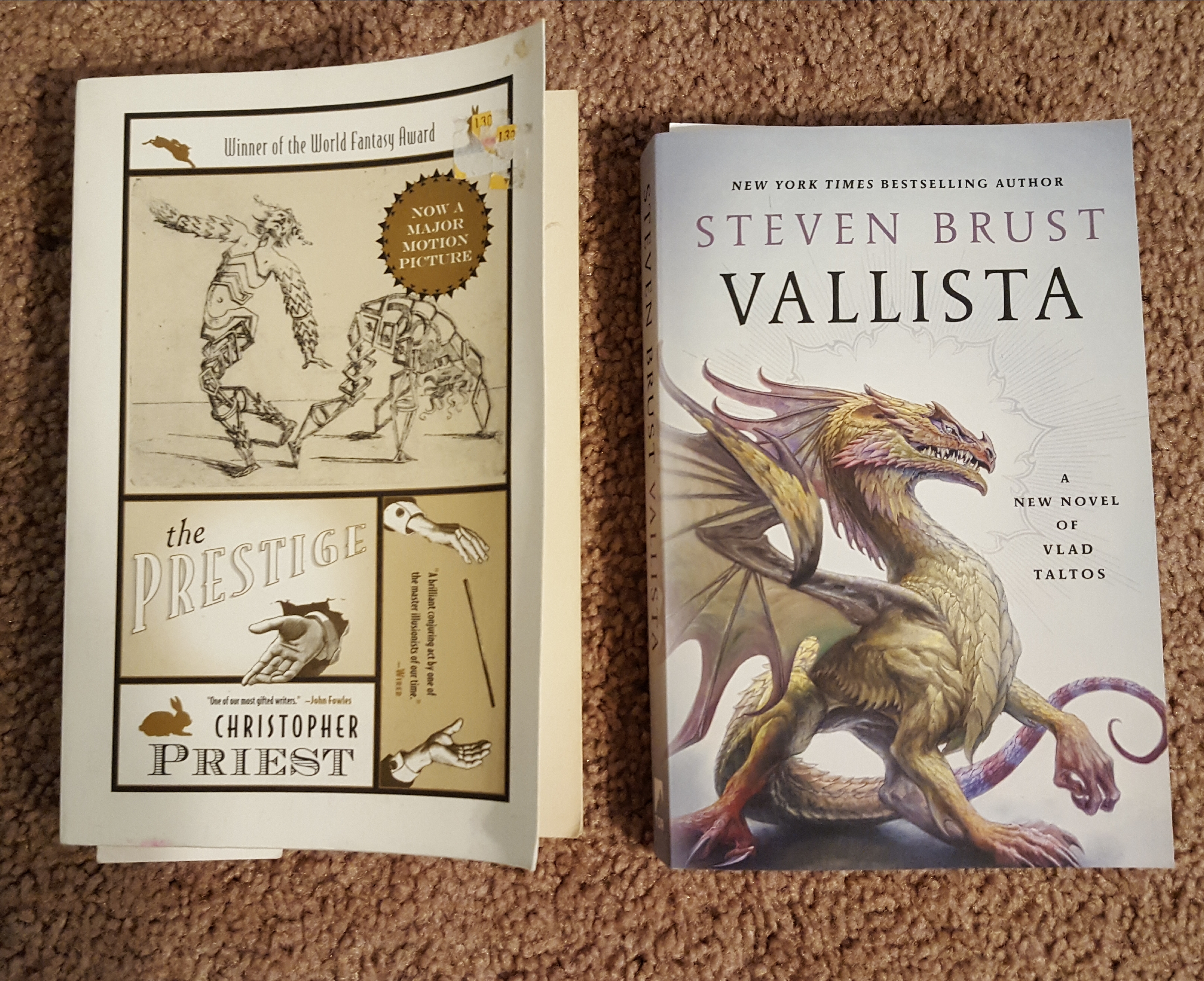
They made a movie out of The Prestige by Christopher Priest, and all I remember was i think Hugh Jackman was in it? And there was some scene at the end where there are like 30 top hats just blowing away? I’m pretty sure another Illusionist/Magician movie came out around the same time, and I might be getting them mixed up. Anyone remember the details of this, or even what year these movies came out?
From seeing the movie, I pretty much already knew the “big reveal” in the book. But friends had told me that the reveal is treated totally different in the book, and boy were they right!!! if you like slow-ish moving historical dramas, this is the story for you! The beginning was a bit slow, and then it ramps up and the drama ramps up, and at the end I couldn’t put the book down. If you’ve not ever read any Christopher Priest because everyone says his book are weird AF (they are!), this is a great book to start with because it’s completely readable and keeps you turning the pages, even when weird shit happens. The further you get into the book, the more weird shit happens. Also? Nikola Tesla has a cameo!
Both main characters, the guys who are feuding, neither of them are sympathetic characters. They are both shit heads, they both feel bad for the shitty stuff they did, and at the end of the book I wasn’t sure who I felt more bad for. I pity them both.
The Prestige is a great place to start with Christopher Priest and Vallista isn’t a good place to start with Steven Brust. Vallista is the 15th book in Brust’s Dragaeran series (but like, the 13th book, chronologically? i’m really not sure). I love this series. When I am feeling stressed out, these are the comfort books I turn to. This series is basically about a guy, Vlad. I’m not going to get into it more than that, because if I did I’d be blathering on forever. If you are that interested, start here, and from there there is about a million directions you can go.
I lovethis series so much because, well, the writing and the story and the characters, they are all fantastic. I love first person POV, i love dialog banter, I love snark, I love long running jokes, I love slow world building. This series has all of that. I love that this series is just about people trying to live their lives, and people who care about their families. Knowing I have a stack of Steven Brust books (many of which are Vlad books) that I can read whenever I want is therapeutic for me. Just knowing they are there, like, it works for me, ok? Being alive at the same time that Vlad’s life is being created, like, it’s a good time to be alive. and yes, I know Loiosh is giving me side-eye right now for not making him out to be the main character. I earned that side-eye!
ok, anyway, Vallista. What a fun book! Devera shows up and asks for Vlad’s help (she doesn’t tell him with what, exactly), and of course he’s going to help her! She runs into a house on a hill (YES, the house from the end of Hawk! eeeeee!!!!), he follows her, and the door locks behind him. This house doesn’t follow any rules of physics or architecture, and when Vlad meets the ghost of the architect, her explanation doesn’t help any. The book gave me Doctor Who vibes, in the best way. The people who Vlad meets in this weird house, he’s got to figure out how to get them to keep talking, because the more he learns about what the hell is going on, the more likely he is to figure out how to get out of this weird screwy house!
if you’re not caught up in the series, so long as you have met Devera, you’re good to read Vallista. I know she shows up in Tiassa, I don’t remember if she shows up prior to that.
I dig this series, because the world building happens slowly. Like, you remember when you were young, and you started collecting books, or comic books, or whatever? You had a little bookshelf in your room, and it slowly filled up. When it filled up, you were really excited – your bookshelf was full! then you got a fullsize bookshelf. and that filled up. fast forward ten years, and you’ve rooms full of books. and you are happy, because they are full, and you are happy because you keep buying more books. that’s what the worldbuilding in this series feels like – just the right amount at a time, at just the right speed. I didn’t explain it well. #sorrynotsorry
A question to my fellow Dragaeran readers: Who is your favorite character in the series?
Stay tuned, one of these days I’ll post about two books I read recently that didn’t wow me!
 Cowboy Feng’s Space Bar and Grille by Steven Brust
published around 1990
where I got it: purchased used
.
.
.
.
.
After Iain Banks’ The Wasp Factory, I needed a unicorn chaser. And by that, I mean I needed a comfort read. Something fun, fast, with witty dialog, a plot that wouldn’t fry my brain, and some sexy romantic scenes wouldn’t hurt either. You know what bookshelf never lets me down? My Steven Brust bookshelf. As my finger went over the spines of Vlad Taltos paperbacks, I hit on a paperback that looked like it didn’t fit: Cowboy Feng’s Space Bar and Grille. Thinking I was going to be reading a fantasy novel, somehow I’d landed on straight up futuristic science fiction! Nice!
This little paperback is everything I was looking for in a happy unicorn chaser comfort read: it was a fast read full of snarky and witty dialog, the plot is a slow burn that was distracting enough to keep me from remembering all those scenes in The Wasp Factory, there was some satisfying (although mostly off-page) sex scenes, much of the book was strange to the point of loopy, and overall it was super fun.
When you’re inside Cowboy Feng’s, you’re always in the same place. It’s the outside that changes all the time. You see, nearly TARDIS like, this bar jumps around the galaxy. Always landing on an populated planet, and always jumping just before a nuclear bomb or other disaster hits the block, the trick is to be inside the bar when it jumps. Cowboy Feng’s serves some excellent food, and they have an excellent house Irish band, so any customers (or musicians) who happen to be in the restaurant when it jumps are along for the ride too. If a space-jumping restaurant doesn’t sound like your thing, read this just for the heavenly food and meal descriptions!
Libby the bartender and Fred the de facto manager have been with Feng’s for darn near forever. Along the way, they picked up Rich and Eve. One day, as the restaurant was getting ready to jump, the members of an Irish Band where there too. Billy, Tom, Rose, and Jamie became the house band that night. Even if they wanted to go home, they have no idea how to do that.
The story is told from Billy’s point of view, and starts just as the restaurant lands at a new location. Everyone gets settled, they scout out the neighborhood, open the bar for business, meet some locals, and the musicians even rent an apartment a few blocks away. And then a murder happens in the bar and the police don’t seem to care. By the way, this is the kind of story in which murders don’t randomly happen in random bars, and the kind of book in which it sure looks suspicious that the cops don’t seem to care. Seems even more suspicious that the poor sap who got killed bears a striking resemblance to Billy.
Traditional Irish music, the best food in the galaxy, a murder mystery, and the possible destruction of humanity. Who could ask for anything more?
Good Guys, by Steven Brust
Posted on: May 20, 2018
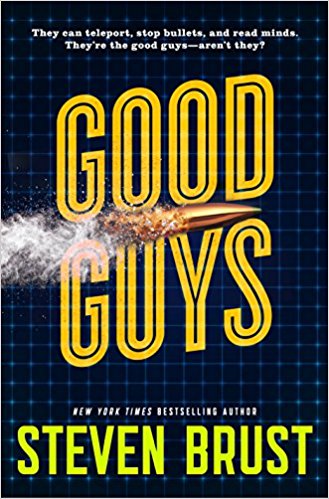 Good Guys, by Steven Brust
published March 6th 2018
where I got it: Purchased new
.
.
.
.
.
What can you do with magic? Pretty much anything you can do without it, except magic makes things much easier, and much faster. Students at the Foundation learn chemistry, molecular biology, and physics. They need to know how everything in the natural world works, so they can learn how to properly manipulate it for the results they want. The applied science of magic is a lot of knowledge, even more practice, and boat ton of will power.
Steven Brust’s newest stand alone novel, Good Guys, is Dresden Files meets Columbo, meets a study in the glory that is non-verbal communication. Donovan Longfellow heads up the American field team for the Spanish Foundation, a secret society staffed by magicians, sorcerers, recruiters, researchers, and assorted administrative staff. As the story opens, Donovan is breaking in his new field specialist, Marci. Fresh out of training, and still thinking she can have a healthy relationship while working for The Foundation, Marci is bright eyed and bushy-tailed, reminding me a little of Gwen from Torchwood. The team is rounded out by Susan the acrobatic ninja, and yep, the three of them are the entire American field team for the Spanish Foundation – saving the world by day, and often working 2nd jobs on the side to make ends meet. They might be saving the world, and the Foundation offers pretty good health insurance, but the hourly wage sucks.
The novel opens with a murder committed by magical means. Donovan’s team is put on the case, and as the murders stack up, the killings become more and more gruesome. None of the people who are murdered were particularly nice people. Someone is trying to send a message, but what are they trying to say, and why? The Foundation tends to frown on people using magic for selfish or violent reasons, so why should they care that a bunch of assholes are getting knocked off? Other than the fact that he’s getting paid for it, why should Donovan care?
 The Skill of Our Hands by Steven Brust and Skyler White
published January 2017
where I got it: purchased new
.
.
.
.
.
.
I went into this book thinking “Yes! More Ren and Phil!!”. Alas, that was not to be the case, as on page one, Phil gets shot and is down for the count for a little while. No adorableness between Ren and Phil? What was I going to do?
Enjoy the hell out of everyone else getting the spotlight, that’s what.
Ren, Phil, you two know I love you, right? Because I totally do. But I am pleased as punch that Oskar and Irina (and Kate!!) get to be the stars of the show for once.
Wait, wait wait a minute. If you have not read The Incrementalists, full stop, go and read it RIGHT NOW. firstly, because that novel is gorgeously awesome, and secondly because this review will make no sense at all and also will spoil tons of good stuff.
Me telling you that Phil, who is now Chuck, gets shot at the beginning of this new novel doesn’t spoil anything for you, and if you’ve read The Incrementalists you’ll know it doesn’t really spoil too much for Phil either. Ren knows she’ll find him again, but in the meantime she’s inconsolable yet still attempting to meddle. As Incrementalists do when they are facing a crisis (because death, although annoying and impermanent for them, is still a crisis!), everyone comes together. There will be arguing, shouting, meddling, gardening, incredible meals, probably some flirting, and does anyone but Irina ever remember to go to the grocery store?
One of the many things I loved about The Skill of our Hands was how the story is presented. That sounds so simple, I know, but hear me out. This is Oskar’s novel, and as he observes Ren, Irina, and everyone else involved with planning what to do now, Oskar interrupts the narrative whenever he damn pleases to make sure you’re aware of his opinion, or aware that he agrees with someone, or aware that he is so deeply sorry that he didn’t trust someone or didn’t believe them. There’s a much bigger picture here that he needs you to see, even if he can’t point to it directly. You’d think his comments might be interruptive, but they totally aren’t. It works perfectly, and it gives the reader this really intimate relationship with Oskar. If I ever have a crisis, I want to have an Oskar on speed dial. Alongside everything that’s going on, Phil’s memories are being explored, specifically his memories of being in Kansas in the mid 1850’s. This book has an earworm you’re going to love.
I’m over at SFSignal today, reviewing Steven Brust’s newest Vlad Taltos novel, Hawk. This is the 14th book in the series, but a surprisingly good spot for new fans to jump right in. Still on the fence? Click here for a review I wrote a while back for The Book of Jhereg, which is comprised of the first 3 short novels of the series.

Even though Vlad spends most of the book saying “hello” to people, the entire novel has an undeniable underlying fatalism, an inescapable feeling that he’s really returned to Adrilankha to say “goodbye”. Vlad isn’t stupid. He knows there’s a chance he’s not going to make it to the end of the book. A really good chance.
Fatalism aside, Hawk allows me to say something I haven’t been able to say about this series in ages: For readers brand new to the Vlad Taltos series, this is an excellent place to jump right in and get a feel for Brust’s wry writing style, the way he does world building and characterization, and everyone’s favorite sarcastic semi-retired assassin, Vlad Taltos.
Read the rest of the review HERE.
Issola, by Steven Brust
Posted on: September 1, 2014
 Issola, by Steven Brust (Vlad Taltos series, #9)
published in 2002
where I got it: purchased used, or maybe paperback swap, I don’t remember.
.
.
.
.
.
.
.
.
.
..
.
.
.
A friend of mine was going to read Dzur, and I hadn’t read that one before, so I decided to read it too. I picked up the book, and instantly learned two things: It opens with the famous restaurant scene, and the story picks up immediately after the end of Issola, which I also hadn’t read. So, promising to come back to Dzur as soon as possible, I grabbed my copy of Issola, which opens with the famous Klava scene.
It turns out Lady Teldra has been sent to seek out Vlad, who has been living rough for the past few years, in hiding from those who would do him or his family harm. She needs his help, because her patron Lord Morrolan has disappeared, along with Aliera. Patron is certainly wrong word, but we’ll maybe get to that later. There is nothing to imply Morrolan or Aliera were kidnapped or harmed, yet they are nowhere to be found. Lady Teldra is so very polite when she asks Vlad for help, and she’s come all this way, and if Sethra Lavode is involved he’s sure to be protected, and really, it would be very rude to say no to the Lady.
Peppered throughout the book are Vlad’s thoughts and his and Teldra’s conversations about manners and the unseen value of observing and respecting the etiquette and formalities of the culture in which you find yourself. An overly basic example is in the East, where humans like Vlad live, it is perfectly acceptable to “knock” on someone’s door to announce your arrival. But in the Dragaeran Empire? such a thing would never be done. This is most certainly not a comedy of manners, but it is a commentary on how they are so ingrained in our culture that after a while we barely notice them, and when practiced, they become second nature. It begs the question of what else becomes second nature while we weren’t paying attention?
There may not have been any overt signs that Morrolan and Aliera were kidnapped, but when Vlad and Teldra do eventually find them in a world that is not ours, they are chained to a wall, as guests of the Jenoine. And did I mention, there is a river of pure chaos flowing right outside their prison? If you know anything about the Jenoine, you know this can’t end well.
The Best of 2013.
Posted on: December 29, 2013
Ladies and gentlemen, it’s that time. If you’ve been paying attention, nothing on this list will be a surprise to you. If you happened to stumble by because you like “year end” lists, these are my top ten speculative fiction books I read this year. Looking for a good read? go find one of these.
Some of them are old.
Some of them are new.
Some of them were borrowed.
None of them are blue.
😉
I’ve linked the titles to my reviews. In no particular order:
Sky Coyote by Kage Baker (1999) – the second in The Company series, this novel is told from Joseph’s point of view (and yes, Mendoza is still really, really pissed off at him). Joseph gets to do one of his favorite things – pretend to be a God. But this time, he’s got to get even the skeptics to believe his act.

The Republic of Thieves by Scott Lynch (2013) – No surprise this one made it to my best of the year list, as this is one of my favorite fantasy series. It’s true, I ranted a little about a character who really annoyed me, but holy shit, that ending?? holy shit! Also, I do just happen to have a Cinnamon colored dress/jacket combo and a four cornered grey hat in the making.
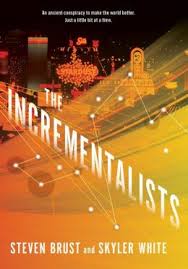
The Incrementalists by Steven Brust and Skyler White (2013 )- Secret societies, multiple personalities, sublime prose, metaphysics, unexpected romance, characters that rip each other to shreds. What more could you possibly want? I got meddled with, my switches got hit, and I never wanted it to end. Just go read it already. Everything about this book was spot-on perfection for me.
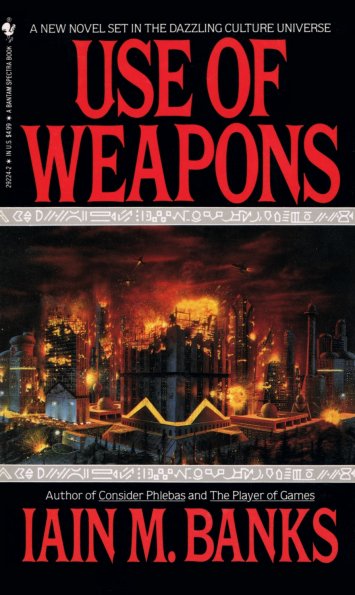
Use of Weapons by Iain M. Banks (1990) – only the best Culture novel of the best space opera series in existence. Not the easiest book in the world to read, but the subtlety, and the reveal at the end, and oh god I knew something was so horribly wrong as soon as he said he was going to cut his hair. . .
I did many cool things this past weekend. One of them was listening to the audio of The Incrementalists. It’s narrated by Mary Robinette Kowal and Ray Porter. I live under a rock and didn’t know who Ray Porter was. Kowal was great (and she gets to read one of my favorite scenes), but this other guy, Porter?
This blog post is not a review of the audio.
You read my review of The Incrementalists and it doesn’t seem like your thing? Fine. I won’t hold that against you. Still, get something else Ray Porter narrated. Do it because you trust me. And do it because this man’s voice does something you to. Something that words and ink and turning pages can’t do.
.
.
You never forget your first time.
.
.
Ray Porter’s voice moves over you like a summer storm. Unstoppable, his voice contains the roiling tension of the incoming storm front, the thunder you feel through your feet before your ears know what it is, the shadow that falls as the clouds roll in, everything to that surreal moment when your breath catches in the silence and the stillness before the storm hits. And then the skies open up, and in his voice are the rhythms of the rain, from gentle caresses to a pounding need to being in every pore of the parched ground beneath; the tympani pulse of the thunder that resonates in your chest; the rain becoming an ocean and drowning feeling like heaven.
And as his voice fades, you are left with the shattered remains of the sated clouds that slowly lie down in repose, their edges set on fire by the glorious sunset.
The storm has passed. And all you can do is reach out with your quivering, cloudy fingers and whisper “you must come back. my ground is still thirsty for you”.
.
.
.
Or I suppose you could just hit play again on the file.
Stay tuned, I have more cool stuff for you tomorrow and the next day. Photos! Links! the awesomess that was ConText! book reviews! you know, more of the cool stuff and less of these weird misguided attempts at prose-y things in which I tell all the rules of writing to fuck off because I’m having a moment.
Interview with Steven Brust
Posted on: September 7, 2013
Way back when I didn’t know epic fantasy from high fantasy, or an orc from a soulsword, my husband gave me a book and said something along the lines of “This is weird, but you might like it. It’s fantasy, but it hasn’t got any orcs or quests or stuff. It’s about a guy who is an assassin, but he doesn’t like, like it. It’s just his job, and he doesn’t nejoy being so good at it, and there’s some cool magic. It’s by that same guy who wrote that book you really liked, The Sun, The Moon and The Stars“. This was like eight or ten years ago, but it really did go something like that. My memory for these kinds of things is awful.
That book was The Book of Jhereg, and I have been a huge fan of Steven Brust ever since. I have yet to find another author whose voice affects me so strongly. I haven’t read everything he’s written, but I am working on it. A little while ago Steven tweeted that he’d be interested in being interviewed about his upcoming novel, The Incrementalists, co-written with Skyler White. After all the big-name famous bloggers chimed in, I quietly raised my hand. One day I’ll realize my favorite authors are just regular people. But until that day, they can stay up on their pedestal and remain superheroes. Before I say anything too much more embarrassing, let’s get to the interview, shall we?
Feeling lost? Go check out my interview with Skyler White, my review of The Incrementalists, or if you have some time on your hands check out all my Steven Brust reviews. You might notice I asked both authors some of the same questions. that was on purpose.

Photo swiped from Wikipedia.
Q: I’ve been a huge fan of yours for years. I’m nuts for Vlad Taltos, nearly ended a friendship because she thought Greg from The Sun, The Moon, and The Stars was an asshole, and I pretty much follow you around twitter. But everyone else reading this might not be like that, so would you introduce yourself, and tell everyone a little bit about yourself?
A: This is tough for a Minnesotan; we get really uncomfortable talking about ourselves. Um. I’ll do my best. I’ve been writing for 30 years, full time for about 26 of them. I’m an amateur musician and poker player. Politically, I consider myself a Red. I’m not an incrementalist.
Q: How did the idea for The Incrementalists come about?
A: I was involved in a sort of complex shared world open source creative commons multi-media project a while ago. Being that far over my head (I understand almost nothing about any of those things), I went out asking for advice. One of the people I asked–because one always asks him–was Tappan King. In the course of the conversation, he mentioned the idea of a secret society operating through all of history and dedicated to making things a little better.
The idea stayed with me long after the collapse of the other project. I was hanging out with Skyler talking about writing process and writer tools and tricks and How To Do It Gooder and stuff, and she mentioned how much she missed the collaboration that is inherent in theater. I remembered what a joy it had been to write with Megan and Emma, so I mentioned Tappan’s idea. We drank whiskey.
 the Little Red Reviewer
Recent Comments